
BASIC, SHOW, COMPETITIVE OBEDIENCE & AGILITY
this page is still being updated/added to (as at 07/02/08).
| THE IMPORTANCE OF TRAINING | |
| DOG THE COMPANION | JANET WESLEY B.I.P.D.T. |
| INTRODUCTION How your dog learns | |
A point to remember -
Ask for a trainer’s qualifications and experience.
Anyone can set up a Dog Training School and call themselves a trainer, the same goes for a Dog Behaviourist
 Many years ago, a dog's life in the city was quite good.
I lived on a housing estate in the '80's and most dogs roamed their patch, lay outside their gates and generally lived a more natural life style than they do today.
Society has changed in their attitude towards dogs and dog owners. Since the introduction of the Dangerous Dog Act - which was the most ill thought out piece of rubbish that I have ever read, but that's another article!- things have altered dramatically. You are now responsible for your dog and his actions. Society now demands that you keep your dog under control AT ALL TIMES. Most Councils are considering banning dogs from public parks, or at least keeping them on a lead.
The dog is not allowed to bark out of control or continuously disrupt your neighbours' leisure time spent in their gardens.
So, if you decide to become a dog owner then you must become a responsible one. Now more than ever do you need to train your dog.
You must be able to call your dog back to you at all times - the law now demands it. You must socialise your dog if you want to take him out with you on day trips or holidays and now with the Pet Passports, being able to control your dog is a necessity. When you decide to have a dog, you must think it through very carefully. The next 10 - 15 years of your life will be shared with this lovely companion. The most important things you must consider is enrolling either at a Dog Training Club or have individual lessons.
Start as soon as you can and the pleasure and pride you will have from owning a well trained dog will be ten fold.
| Return to Top of Page |
DOG THE COMPANION
I believe that the dog must be treated with the utmost respect. If we can treat each other with respect, then why not a companion who communicates in a different way. This also applies to all animals.
So many times I see cruelty and dismissal. Rejection is terrible. When you walk into your home and the dog jumps at you to say "Hello" so many times do I see the pain of rejection. You bellow "Get Down" or even smack the dog. You are wrong. If a person you loved shouted at you and ignored you, you would soon become withdrawn and confused.
Stop, take time just to say hello to this lovely friend who is giving you such a greeting.
I hate the abuse of the Control Freak or the moody and nasty individual who takes sick satisfaction out of bullying and cowering a dog for no reason apart from their own nastiness. The Control Freak has to show power by constantly being overbearing and keeping the dog in a constant state of fear.
Yes, these people do exist. If they cannot inflict their abusive and cruel ways on other people or children, then the closest thing to man is the Dog!
There is many a cry and squeal of pain that is repeatedly heard from a neighbours dog that is repeatedly ignored.
There are so many sad eyes in a backyard, that live in stench and squalor, hardly fed, never brushed, tied to a pole.
There are so many old dogs with matted and dirty coats, long overgrown claws, they can hardly move. Simple veterinary attention could relieve pain, make them more mobile, giving them a quality of life.
THIS SILENT NATION SUFFERS THE MOST HORRENDOUS CRUELTY, NEGLECT AND ABUSE THROUGH NO FAULT OF THEIR OWN.
It is up to everyone who owns and loves a dog to fight these so called 'dog owners'. Support the charities who try to help - always report cruelty to the authorities.
Become Guardians of MAN'S BEST FRIEND....
| Return to Top of Page |
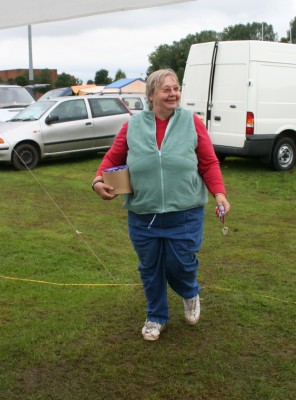
My name is Janet Wesley.
I have trained dogs and handlers in puppy management, obedience, agility and behavioural problems for the last 30 plus years.
I have bred GSD’s since 1977 and have bred and trained dogs that have qualified Crufts.
I have trained my own dogs to Test “C” Obedience.
I have managed my own Dog Training School since 1972 and I train and manage a dog display team.
I have trained Security dogs, P.A.T. (Pets as Therapy) dogs, school visiting dogs, and hospital dogs.
I am qualified with the British Institute of Professional Dog Trainers.
I have enjoyed every one of the last 30 years and have never stopped learning about ‘’Mans Best Friend” who I love so dearly - THE DOG
| Return to Top of Page |
The first thing you need to know is how your dog learns.
Your dog learns the same way that we do. Good experiences and bad experiences. Pleasure and pain.
It is your responsibility to treat your dog with tolerance, patience, kindness and love while you are training him. If you praise him and reward him for an action, he will repeat that action. If you hit or scold him for a certain action, he will stop doing the action out of fear, but he will only remember the fear and can forget the action - that is why they often repeat the action again.
Every animal responds in a more positive way if taught kindly and rewarded with treats. One of the saddest sights I have seen is when a hand is extended to say hello to a dog and the poor thing cowers and trembles because he has been hit repeatedly. The hand to him is an instrument that punishes him and hurts him. This makes me very angry.
Everyone at some time is firm and at times will smack their dogs, but to inflict terror and fear on any animal is totally unacceptable behaviour and should be punished by the Courts.
So, back to basic training. Find yourself a good dog training club. Contact the Kennel Club and they can send you a list of registered clubs in your area. Shop around, as some clubs are better than others.
An outdoor school is preferred, as outside is where your dog needs to be obedient. Indoor training can work, but only if the numbers are small and the class controlled.
I have found that indoor clubs can be where the dog learns nothing because of the noise, dogs barking, people shouting, dogs fighting, puppy’s frightened and cowering, the trainers shouting louder and louder to be heard, handlers dragged around the hall by dogs so overcome that they are dragging their handlers out of the door, ABSOLUTE BEDLAM! The dogs and handlers so exhausted and traumatised that neither can remember what they have learned and dreading the next lesson! You have been warned!
With your puppy, try to find a puppy class where he can socialise and play. This will help you and your puppy.
Train your dog every day as he will learn more quickly and will soon be moving up to the top of his dog training class. The dog will only be as good as the effort you put in. If you don’t train him between classes then he will not progress. Do not blame the Dog Training club!
A point to remember - Ask for a trainer’s qualifications and experience.
Anyone can set up a Dog Training School and call themselves a trainer, the same goes for a Dog Behaviourist
| Return to Top of Page |
e
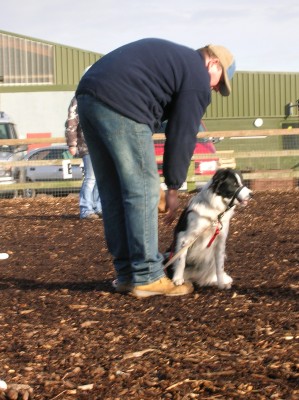
When you have trained your dog to come when called, get into the habit of commanding 'sit'.
To do this, make sure that you have tasty treats ready. Reward your dog for coming when called and then, with the treat, move your hand back over your dog's head and, as the dog follows the hand back, he will sit. Make sure you command 'sit' and then reward.
Another method is to gently, and I stress gently, push the dog's bottom down. Make sure the push is over the dog's hips, not higher. Reward as soon as he sits.
Make sure you command as he sits so that he learns quickly, always praise and reward him with treats.
When he is sitting, go for a longer sit. Count to five, then ten, commanding 'sit' all the time, then reward and praise. This stops the dog sitting and standing up instantly. It is also the start of the 'sit, stay'.
Once your dog or puppy has learnt to sit, then make him sit every time you put his food on the floor. Sit before the lead is attached, sit before you open the door, sit before you cross the road, and teach him to sit for a short length of time before releasing him.
Sit is a control exercise. It is a position where the dog has to learn to control himself. He has to resist the temptation to move, walk away, sniff the floor, etc. so it is an important exercise that should always be rewarded.
When teaching the sit, always make sure that the dog responds quickly. If you get into the habit of repeating the command, i.e., sit, sit, sit, you are actually teaching him to ignore the first few commands - a bad habit to start. First command, if he ignores then push his bottom down.
Do not start slapping your dog into a sit, it is painful and there is no need for it. With a puppy, you could damage their hips. You could also make him aggressive - with some breeds, they will snap if you hurt them. Keep your hands off your dog as this kind of punishment is very rarely needed when teaching the sit.
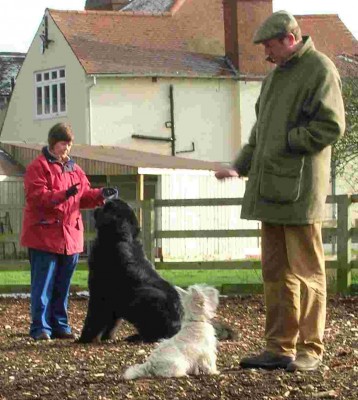
It is better to start training as young as possible then any aggressive tendencies are controlled at a young age, making a well balanced pet for the future!
Sometimes a puppy can sit, but not for any length of time. This is because they become easily distracted, or forget the position they are in. Keep your cool and try again, but if your dog resists being put into the sit or persists in getting up instantly, or is in discomfort when going into the sit, then ask your vet to look him over, just to check that there is nothing wrong.
Some dogs can get a bit snappy when their bottoms are pushed down, this can be due to one or two reasons.
* He does not like you around his back end
* He is being dominant and refusing to submit to you as the pack leader.
* He could have an anal gland problem. (These are inside the dog's bottom and
are glands that can become blocked and a vet's attention is needed).
* Pain when sitting. If there is a health problem, the vet is the person to tell you.
If you think you have accidentally hurt your dog and that is the reason why he has snapped at your hand, never go daft and apologise, kissing him and loving him as this can cause behaviour problems. You can appear submissive and this could encourage dominance. The dog learns that to snap at you makes you submit - Great.
Some dogs will treat you like a pup and growl because he does not like your face in his face cooing like a lovesick pigeon! He will growl to tell you to go away, just like he would a pup that is pestering him.
If ever you accidentally hurt your dog while training, the best thing to do is to ignore it and carry on as though nothing has happened. This will help the dog to forget very quickly.
Some dogs are grumpy by nature; they very rarely do anything more than moan. Accept that he is a moaner. Do not over react, just say no, but really praise him and reward him for sitting on command, they soon stop moaning and you win in the end!
Some breeds do 'moan' and 'talk' while being trained. The Rottweiler is one example, but there is a big difference in a dog that snaps or bares his teeth in anger. I have had to retrain dogs that have been beaten by owners and trainers for moaning and this has made the dog very aggressive where they cannot handle him or groom him.
These are very sad cases where the true nature has been replaced by a fearful angry creature that distrusts and hates man. These cases are very few and far between; most are destroyed as the damage has already been done. © Janet Wesley
| Return to Top of Page |
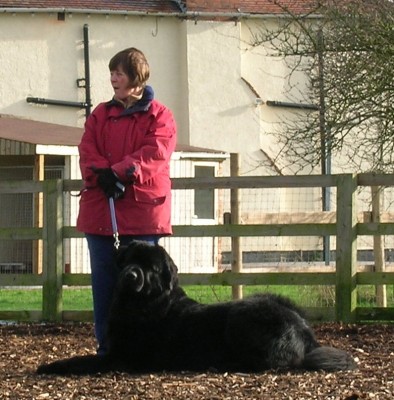
The Down Position - When you start to train your puppy or an older dog, enrol with a Dog Training Club, where your progress can be monitored and problems stopped before they become mountains!
Teaching the "Down"
This method of teaching Down is simple and rewarding for you and your dog. Make sure you are on your own with no distractions. Start with your puppy from 6 weeks onwards. The best way is with treats - incorporate the 'come' and 'sit' with this exercise. The reason for this is because the dog will be relaxed and already eager to please as you have already rewarded him (with treats and fuss).
Call your dog - reward him, then sit him - reward him. Then show the dog his treat and slowly move your hand down to the floor. Gently press on the dogs' shoulders to encourage him to follow the treat into the down position. Reward him, stroke him commanding soothingly 'Down', keep repeating the command to a count of five, finish and reward.
Keep your voice calm and once he is down, stay with him and sooth him. Your dog will soon learn that there is pleasure with this position. With young energetic dogs, tickle their tummy! This can relax them.
Do not stand up to start with, as this can be a signal to move with you. Then you have to start all over again. Keep the dog down to a count of five and release.
When the dog is laying quite happily on command, then start to stand very slowly. If the dog follows you up, slowly push him back down.
Start to use the 'down' command as often as you use 'sit'. Start to alter your commands - sometimes when you call your dog, make his first position 'down'. This brings variety into your training.
For some unknown reason, handlers can become very loud and threatening, sometimes bellowing in the dog's ears. This frightens the poor thing and all it wants to do is run! The handler gets louder - the dog starts to resist. Then a battle of strength begins. Determined looks on both faces, who will win?
Then the wrestling match begins. Legs being pulled all over the place, tails being grabbed, the handler ending up lying on top of his dog! A triumphant look on the dogs face. (Oh, HAPPY DAYS!) For some dogs, this position can be very stressful. Some dogs will fight and resist you, some dogs will growl and complain and will bare their teeth. If this happens, you must seek advice. A training school or some other qualified professional. I stress QUALIFIED.
DO's And Don'ts
DO NOT
Do not smack your dog or lose your temper if your dog is sometimes a little slow to go down, especially the young dog, sometimes he will have his mind on other things.
How would you feel if when told to do something, you were not as quick as normal and were abused, smacked and forced to move quicker! Aggressive behaviour towards your dog/puppy is very rarely needed.
DO NOT BULLY YOUR DOG!
Do not rebuke your dog if he does not respond straight away to 'Down'.
It is a complex position for your dog and it must always end up being a rewarding experience for him.
Do not start to use 'Down' as your 'Bad Dog' command.
A lot of owners will bellow 'Lie Down' if the dog has done something wrong - and then they wonder why the dog is so unhappy when they try to teach 'Down'!
DO'S
Do start to slowly decrease your treat reward when he is going 'Down' on command.
Focus more on your voice and hands as the reward. The reason for this is because I would like him to respond to your voice and to respond to you and for him to want to please you.
Give him a treat for every other 'Down'.
Put the 'Come' 'Sit' and 'Down' together and reward him with a really tasty treat after doing ALL THREE.
But make sure you fuss and praise him for each individual position.
Do tell him that he is a 'Good Boy' when he responds to your command.
UNDERSTANDING "DOWN"
Most of the other positions mean nothing at all, apart from the fact that if they adopt the desired position, they will get a reward.
The 'Down' position can cause problems and some dogs will show aggression if forced to go down - I will explain why:
The first thing you need to understand is what the 'Down' position means to the dog. When dogs and puppies play, it is the one who is down on the floor with the other one standing over him that is the loser. When dogs spar or play fight, again the one on top is the winner. When dogs fight, the one on top of the dog's neck is the challenger, so you can imagine with some dogs, when you bend over them pressing on his shoulders, you are in a challenging position and some dogs will resist you, even warn you.
This does not necessarily mean that he is aggressive, but confused. His response is instinctive, just as he would to a dog on the back of his neck, which is why your voice should be calm and a nice tasty treat as the incentive. This helps the dog to understand that there is no threat.
When dogs fight, the loser is forced to the ground, here again trouble can arise. If you watch puppies with an older dog, they grovel to them - they are lower than the older dog. This means that they are no threat to the older dog and any puppy that oversteps the boundaries is very quickly forced to submit. So here again, some dogs may think that you are angry because you are making them submit to you, that's why you should adopt a soothing voice if your dog is worried. When you make your dog go down it makes you the 'Top Dog' - the leader. You are making him submit to you.
Do not train your dog to go down as a nice happy position and then start to use it as a 'Bad Dog' command. For example, "You bad dog, lie down". Just "Bad dog" should be enough. Never bully your dog and never allow any other members of your family to abuse him either. We all want a happy and contented companion.
Some breeds can resist the 'Down'. Some dogs dislike going down in the company of other dogs. Some of the Terriers will fight the 'Down'. The large guarding breeds can also find this position threatening; he is vulnerable, he cannot defend himself, or you. You have to be very confident and firm with these dogs. Weak handlers will struggle.
Nervous dogs find the 'Down' very distressing and you need to be calm but sometimes firm to get them to settle. Always praise and reassure them when down.
Generally, there are very few problems with 'Down', but this at least gives you some understanding of what you are asking of your dog.
| Return to Top of Page |
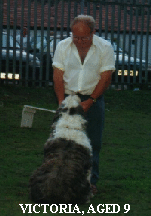
The most important thing is to train your dog to COME ON COMMAND.
The very first thing to do is to make sure that your dog responds quickly and sharply to his name on the first call. A dog who ignores his name or responds after 5 calls is unresponsive, and if something takes his attention he will be away like a dot in the distance leaving you holding the lead and feeling very annoyed!
Start teaching him to respond to his name in the home. Call his name wherever he is and reward instantly. Call him often throughout the day.
For your dog to respond to his name, call him and as soon as he responds reward him with food. Not his normal food as this can be boring - make it tasty, something worth returning for! Chicken, liver, sausage or various packet treats and swap them around so that he never gets bored.
You must praise him and fuss him. Make your voice happy, pat him, show your pleasure. Don't bother with sit, you are praising him for coming to you.
Call him to you when he is playing, either in the house or in the garden, and every time he comes to his name - reward him and fuss him and let him go and repeat the exercise again.
When your dog or puppy is coming when called, add the command of 'here' 'come' or 'to me', i.e. 'Sally, here', emphasising 'Sally' - pause, then 'here'.
Now we are training!
IN THE PARK - or any public place
The dog has to respond in the park or any public place. The general public now expect you to keep your dog or puppy under control!
Before you release your dog, make sure that you are alone or any distractions are a long way off. Your dog will learn more quickly if you are alone.
Release him and let him have a little run and then start to train him. Call him, praise him, reward him. Keep doing this at intervals along the walk. If your dog has a tendency to run too far away from you, clip a long line on. With this you will always be in control.
Get into the habit of allowing him to go no more than 15 - 20 feet away from you. Call him, reward him. Let him go to the distance that you want him to go and call him again, then reward him. This will stop the problem of the dog running so far away from you that getting him back quickly is impossible.
IN THE GARDEN
Call when the dog is in the garden. If the dog refuses to respond in the garden or is very slow, it could be that the dog regards this as his area. If he ignores you in the garden, then he will in the park, as the park is much more interesting.
If the dog doesn't respond or you have to call him more than once, invest in a long clothes line or a 30 foot tracking line from the pet shop. Clip onto the collar, call the dog. If no response, call again, firmly tugging on the rope and then praise and reward.
PROBLEM SOLVING
As with any training, other methods have to be used, or a mixture of different methods. This can make training more interesting for your dog.
If you have problems with your dog not returning on command - this can happen at any time throughout your dog's lifetime - the methods below will help. Try to make training as interesting as possible. When boredom sets in, so does naughtiness.
If your dog ignores your command, try to hide. Your dog will be so anxious because he cannot see you he will think he has lost you, he will be more responsive the next time. If you can't hide, then bend down close to the ground. Again, the dog will be anxious. When he comes to you, praise and reward him with treats or a play with a toy.
You could try turning and walking away from him, calling him all the time. This often gets their attention. Again, praise him. If these methods fail, use the long line and be firm.
Keep him on the long line until he responds. DO NOT take the long line off, let him trail it. Only when he is responding should you release him. This can take a while - between 4 and 8 weeks but you must train him every day. This method works well with dogs that have been rehomed.
Take toys with you, call him and throw his ball a few feet away from you. This often gets him back. Throw the toys in the air and squeak them, this again can work.
Train to the whistle when training him outside. Blow the whistle after his name, then reward on return (food and fuss). As the dog responds, drop his name off and rely on the whistle to get his attention.
This method often works with the gundog breeds. It also helps if the dog is a long way off or cannot be seen. The whistle will be heard better than your voice. There is no reason why the dog cannot be trained to both voice and whistle and I know many dogs who are. © Janet Wesley
If you have any problems, email us for advice. problems@worldofdogs.cc
| Return to Top of Page |
The "STAY" can be used as an emergency STOP, as an aid to stop your dog running off, a command needed while getting in and out of the car. It is also needed while grooming your dog.
It has so many important and practical uses that makes it one of the key training exercises. The "STAY" has been broken down into easy to learn sections.
HERE WE GO...
Puppies in particular can make this into a great game, so the lead stops this happening.
Place your right hand in front of his face with the command "SIT STAY". The command needs to be firm BUT not loud. Remember you can unnerve some dogs if you are over powering!
Leave your hand in front of his face approx 2ft away. Keep repeating "STAY" and take one step to the side.
As you step to the side tell your dog to "SIT STAY". With the lead in your left hand, which should be loose, not tight, as this can cause the dog to move. Count to ten and return to him. As you return, tell him to "sit". Keep him sitting to a count of five, then finish. Reward with praise, fuss and treats in that order. Try to keep food as your last reward.
HOW TO START AND WHEN.
One of the easiest ways is at meal times. Make your dog "SIT," put the food on the floor, and stand at the side of him. If necessary, hold his collar, command "sit stay". Hold your hand in front of his face as a signal commanding, "stay, stay". You must keep repeating the command with your hand still in front of his face, with your other hand on his collar.
Count to ten, command "finish'', in a light and happy way, and let him have his reward - which is his meal.
If you try to teach the dog too many things at the same time, the dog can become very confused. Always take time to teach one exercise at a time, and only when your dog fully understands what the command means, do you go on to teach another exercise.
When you start to teach the "sit stay" teach him in the home, in the garden, and in the park, infact where ever you take your dog, use this as a time to train him. At first make sure it is quiet, with no outside distractions, your dog will learn so much quicker.
When your dog is staying in the sit position with confidence then increase your count to ten.
When he is rock solid then and only then, take another step away. That makes two steps when you leave your dog. Increase your count to twenty, commanding "stay" all the time.
Slowly, and I stress slowly increase your distance to the side, and the length of time he has to sit.
If you take your time with this position your dog will be totally reliable. Never rush this exercise, if you try to put too much distance between you, it can encourage him to move, and once this starts to happen you have to return back to the beginning.
Slowly but surely wins the day!
This is a control exercise, and you need to understand what you are asking of your dog. You are not allowing him to move, walk around, sniff, or play. You can understand why some dogs find this difficult.
Never bully your dog if he moves, just start again, and really praise him when he has done it correctly.
When your dog can do a "sit stay" at a short distance for 30 seconds with confidence, then and only then leave the lead at the side of the dog. With the lead still attached to the dog it helps him, because with some dogs when you take the lead off, then he can think the training is over. Also, if he moves it is better to grab his lead instead of his collar as some dogs will not like you grabbing them around the neck. This can lead to problems! It can unnerve some dogs.
So keep the lead attached on the floor at the side, until you and your dog are more than ready to start off the lead stays. © Janet Wesley
THE NEXT STEP.
Time for off the lead.
| Return to Top of Page |
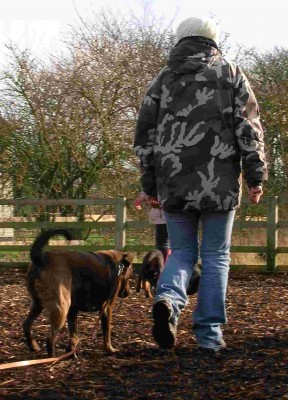
"Heel" means to walk close to your body, head at the side of your leg. This position is a control position, which is very useful.
When you cross the road, when you are walking through crowds, when you require your dog to stand quietly at the side of you. It is also a position that is required for Competitive Obedience.
As with any control position it teaches the dog to focus his attention on you and teaches him to control himself. It is also a position to use if he is frightened of something, or showing undue attention towards people or other dogs.
It simply means "Back, stay close to me and walk past whatever we come across" on the command "Heel".
TEACHING HEEL
- Now you have to get your dog to follow you. One way is to start from the 'sit' position. Show your dog his treat or toy. Move forward on the dog's name and "Heel" command.
Always use your dogs name to get his attention; do not forget to praise him when he looks at you.
- As you move forward, use the food as bait to keep your dog following you. You must keep commanding, "Heel" and praising him. The dog will then associate the command with being close to you.
- Walk forward for approximately 10 - 15 paces. Command "sit", and reward with plenty of praise and fuss, then give him the treat.
Use his name, praise him, show him his treat, use his name, command "Heel", walk forward, commanding "Heel" all the time, praise him, walk forward 10 - 15 paces, command "sit", stop and praise, give him the treat.
Make your command of "Heel" quite firm.
The reason being if you have to get your dog quickly under control, to either go past an obstruction or past something he is wary or angry at, he must have enough respect for you that he reacts to the voice.
If you use a firm, steady tone with plenty of praise when the dog responds he will learn quickly.
When I say firm that means with some authority in your tone.
Not loud enough so that you are not just training your own dog but everyone else's on the park!
Compared to a dog's hearing, we are more or less deaf, so your dog does not need you bellowing "Heel" in his ear!
With a nervous dog, this can be very upsetting as the louder you get the more annoyed you sound, so the poor thing ends up pulling away from you and you checking and bellowing even LOUDER! Oh, happy training days!!
The other way of teaching "Heel" is more on the lines that you teach the dog by physically stopping him going forward.
Either the garden or the park is the place to start, remember that the garden is a good practice area for all of your training.
- While the dog is walking on a loose lead on the command "steady", stop, call him to you, make him sit and go down, reward.
This has already prepared him for work.
Walk forward, using his name first, and then "Heel". When the dog's shoulders go past your knee, check him on the command "Heel". - Keep walking, giving the dog a slight check every time his shoulders go past your knee. I stress a SLIGHT CHECK.
You must check on the command "Heel" and then praise him for responding. Keep him to "Heel" for 15 paces. Make him sit on command. Fuss and praise him and treat him. Let him go on a loose lead or play ball with him as a reward, then repeat the training again. - When your dog is walking to "Heel" for 15 paces, then start to vary his training. While on "Heel" stop and make him go "down".
Remember to praise and treat him. Move forward on "Heel", stop and do a short "sit, stay" return, and move forward on the command "Heel". - Bring all of your different exercises into the "Heelwork".
Extend the amount of time your dog is kept at "Heel",
BUT it must be fun and interesting for your dog at all times.
For your dog to progress in any of the exercises, he must be trained every day. You will be surprised at how quickly he comes on, but only do training for about 10 - 15 minutes each day to prevent boredom. © Janet Wesley
| Return to Top of Page |
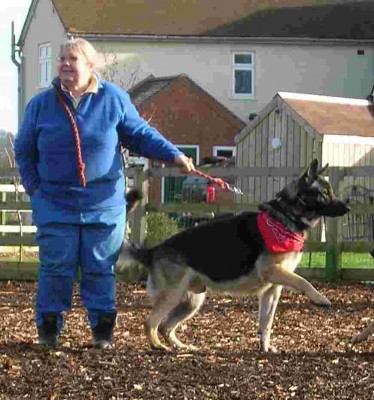
- Some dogs are bred to pull. The HUSKY breeds will, given the chance pull you over many miles. If you buy a Husky breed, you know what you are letting yourself in for! They can be taught to walk but you have to be patient.
- A happy, bold and confident dog likes to escape from the confines of home and garden, so their enthusiasm can make them pull.
- One of the main reasons for pulling is the fact that, compared to a dog, we are such slow and cumbersome creatures. Two legs will never go as fast as four!
- Another reason for pulling, which is often overlooked, is nerves. A nervous dog who is frightened of traffic noise, people, or just lacking in confidence can pull, not knowing where they are pulling to, but pulling to get away from whatever is frightening them. These dogs need specialized help.
- Some dogs not only like to lead, but will insist! This can have something to do with the Pack Leader. The Pack Leader is the one who leads, so sometimes a battle can pursue.
He will learn the long lead walk and the 'heel' position.
Whatever you do, do not keep your dog restrained on a tight lead at the side of you as this can be very uncomfortable for your dog. He needs to be able to move around, sniff, and enjoy his walk and only held to 'heel' if needed.
A dog likes to have all round vision. He likes to see behind him and to be able to see to the sides and forward. German Shepherds in particular like to be in front. This is something to do with their protective instincts. They like to be able to see what is approaching, especially at night.
With all of this information in mind, the first position you will teach is 'HEEL' and 'STEADY'.
The best way to teach your dog to 'walk' is to go to a Qualified Trainer who has more than one way of teaching the 'walk' - you may have to look around to find the experience needed.
The time to teach is from a very young age and once you have started you can never really stop demanding a response to a command. I have known owners who have stopped taking their dogs out because of their dogs pulling them about!
- A long training lead - approx. 4ft. to 6ft. long.
- 2. A plain collar (of either nylon or leather) or one of the nylon and chain collars called a restrainer. The restrainer being the most popular (There is a correct way of fitting this collar, please see 'Collars and head collars at the end of 'Heel' section).
- Start to control your dog straight away. It is a good idea to start in the garden. Always make sure your dog sits before you put his lead on. Walk forward, let the dog go to the end of the lead. Stop and check the dog with the command 'Steady'. As soon as you have checked him, let the lead go loose and walk on.
- As soon as he reaches the end of the lead, stop, check and command 'Steady'. Keep the lead loose and walk on. We are trying to teach the dog to walk on a loose lead without pulling. Keep walking around the garden until you and your dog start to get used to the new technique.
- To make it more interesting, at times as you stop, call him to you make him sit or go down and reward with a tasty treat and fuss.
- As soon as you feel confident, take your dog for a walk. Make him sit at the gate, hold him to a count of five. If he pulls to the gate, check him on the command 'Steady'. If he pulls hard, be firm and check him back sharply.
- If he persists then take him back and start all over again, he will soon learn.
- The same thing applies in the street. If he pulls in any direction to the side or back, check him on the 'Steady' command. Always tell him what a good boy he is while he is walking. © Janet Wesley
| Return to Top of Page |
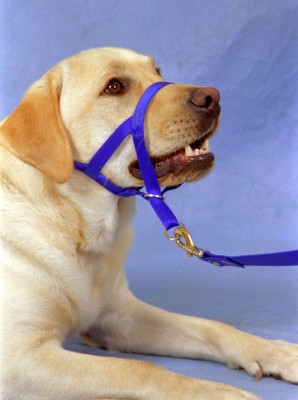
Many times over the years have I seen pet dogs strung up at the side of their owners. Their heads twisted at a ridiculous angle!
This can lead to back and neck problems, you only have to see these dogs walking in the street to understand the damage that can be done.
The dogs cannot see properly, they cannot put their heads down into a relaxed position. They cannot sniff, they cannot even cock their leg!!
Owners then wonder why when they do try a collar, the dog goes absolutely mad, dragging them everywhere. SUCH FREEDOM!!
There is nothing wrong with the product BUT everything wrong with the way it is USED.
 |  |  |
| Halti with link |
HOW TO FIT THE HEAD COLLAR.
 |
Some dogs can get quite distressed when the collar is first fitted. They will scratch at their face and try to get the collar off.
Only when the dog is comfortable with the collar, and I STRESS ONLY then do you attach the lead.
The dog will walk forward until the lead actions the collar, which stops the dog going any further.
The best place to try this is in the garden, have plenty of treats with you, and keep your dogs attention on you and get him used to the lead.
At first the dog will try to fight the collar, keep the lead loose, I repeat LOOSE.
The dog will soon start to settle down, and learn to respect the collar and lead.
If the dog pulls on the head collar, then use your steady command, and gently guide the dog towards you and immediately loosen the lead again.
The lead must be loose at all times for your dog to enjoy his walk. Freedom of head movement is crucial to the dog's health and well being while out with you and your family.
A qualified trainer will help you with any problems, although some trainers do not advocate the Head Collar.
Please do not hesitate to E-mail me for advice [Click Here]. © Janet Wesley
| Return to Top of Page |
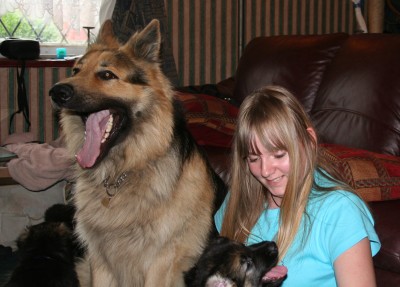
Dogs need to know every person in the family, especially the children.
Start as soon as you get your puppy. Let every member of the immediate family take it in turns to feed the puppy. Even very young children under supervision, can put the bowl on the floor. This will get puppy used to seeing children around the food bowl.
Training - everyone in the family needs to use the same commands. Too many different commands will most certainly confuse the puppy.
If you enrol at a Dog Training School, which I strongly advise you to do, then all the family needs to attend to see how the puppy is trained. You do not need to all go at the same time, but children do need to learn to respect dogs and training schools can do this.
- Do not allow anyone who visits you, to treat your puppy anything other than kindly- that includes other members of the family, including the children.
- Never allow anyone to tease your puppy it may be fun now, but not when they get older and people get bitten through bad puppy management.
- Let the puppy sleep or rest quietly. He is not a toy to be played with whenever you decide, or when the children want something to drag around or dress up!
- Avoid play fighting where the puppy is encouraged to show aggression. Here again the puppy knows no boundaries and when he goes too far he will be smacked for biting too hard and then when puppy gets older and his bite harder - I need say no more.
Stop it happening before it starts. Supervise the play, encourage the children to use toys and tug toys. They can have just as much fun without teaching the puppy bad habits. Your children may be able to play rough, but your neighbours children may not enjoy being chewed on by your cute lovable puppy!
Remember most attacks on children are either friends or neighbours children who the dog knows, not always the immediate family's children. A puppy when in a highly excitable frame of mind can get carried away - this often happens when there are no ground rules and no adult supervision.
Rules have to be kept. When you get your puppy, make sure the ground rules are in place. Make sure every member of the family, including the children understand them.
Decide where the pup is to sleep - is he allowed upstairs, is he allowed on the furniture, is he allowed full run of the house while you pop out? Involve everyone and then owning your puppy should be fun for all of the family.
| Return to Top of Page |
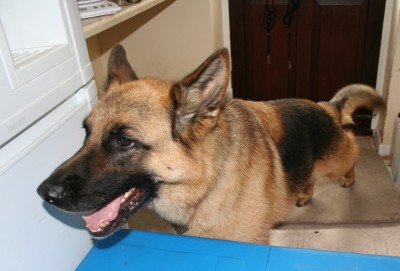
I get so many people with problem dogs in the home for example - "My dog goes into my bedroom while I am at work and chews my bed". Confine your dog to certain areas while you are out. Either the kitchen which is a favourite, or the hall with a stair gate to stop him going upstairs, or the hall and kitchen which some people prefer, so that the dog can guard both back and front of the property.
As the dog gets older they can, if they choose, have more freedom while left, but do not expect a young dog or one that suffers anxiety problems to behave - they won't.
Some dogs have being confined and will settle if they can roam the house, but here again be careful of giving a very young dog that amount of freedom.
You can allow dogs to roam the upstairs, but close the bedroom doors so that access is limited and so therefore damage will be limited. Kitchen, hall and landing upstairs is the area that most people allow their dogs to roam, access to the lounge, bedrooms and bathroom is denied.
It is entirely up to you as to where you allow your dog to roam in the house, but you need to designate an area so that the dog gets into a routine.
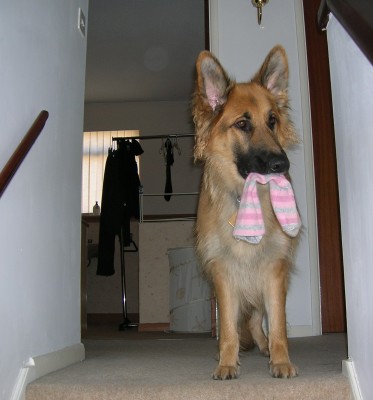
If you are at work, a young dog will become bored and yes, he will get naughty.
Anything worth chewing will be chewed, anything worth stealing will be stolen.
If you have a dog, make sure someone can let him out for you or otherwise, he will take to fouling. You cannot blame the dog when he is left for many hours.
The elderly dog can suffer too. They need access to the garden more often. I hate it when people say “My dog has turned dirty”. NO HE HASN’T, he has just got older, that’s all. Dogs are very clean animals by nature, consider his age and make arrangements.
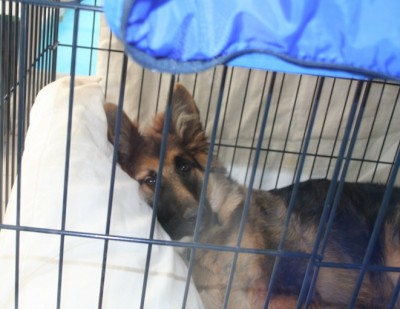
These can be very useful if your young dog is totally unruly when left.
But there are things you have to do to train your dog to stay in the cage.
- Make sure the cage is big enough. There must be enough room for him to stand, turn around, enough room for his basket, food and water bowls and toys. In fact, as big as your kitchen or hall will allow.
- It must be a nice place to be, so feed your dog in there and put his bed in there. DO NOT close the door for a good while, let him get used to wandering in and out.
Put his treats in there and close the door, but stay in the room and keep the time short. Do this on a regular basis and your dog will soon settle in his cage. - Start as young as possible and be considerate at all times. DO NOT scold him if he whines, but praise him when he is quiet.
- Make it his ‘den’. Throw his ball into it and fuss him while he is in there.
I know of dog owners who would have probably parted with their naughty dog if not for the cage!
So wherever you decide to leave your dog, make sure it is where he can do the least amount of damage.
| Return to Top of Page |
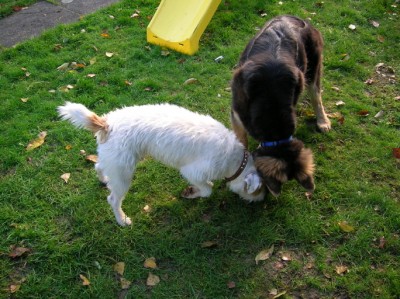
Most dogs at some time have dug holes, pulled plants up, chewed plant pots. You must realise that a young playful puppy or young dog has no idea that certain plants must not be pulled and chewed.
When he goes into the garden it is a wonderland of different sights, smells and sounds.
There is so much to do, try to dig a den! Chew objects to help my teeth come through, taste all the plants, play killing with some of them because they are soft like a small rodent, practice throwing them up in the air and catching them, shaking them just in case I catch the real thing. Hooo what fun!
So be prepared.
Your puppy or young dog doesn't know anything about the value of your garden and if left unattended he will PLAY. There are however, things that you can do to prevent alot of these problems beginning.
- Don't leave him alone for too long. Watch him and as soon as he starts to do something he shouldn’t, then tell him “No” and distract him with a toy
. - Make sure he has plenty of interesting toys. I say interesting because he could very quickly tire of some toys e.g. cloth tug toys are good because a puppy can throw them around.
- Don’t leave him outside on his own too long. A lonely puppy will get naughty and can start to learn to bark for attention. Here again, problems for the future.
- Leave the door open so that puppy can be with you if he wants. This helps with an anxious puppy who needs contact with you. They soon start to leave you for longer periods of time because he is not restricted. Some puppies when you close the door can fret, so therefore they do not enjoy being in the garden.
- If there are parts of the garden that you do not want your puppy or dog to play on, then the simplest thing is to build a fence. There are so many fancy types of fencing that will restrict puppy’s domain.
- A compound for your puppy is also something to consider. I know alot have dog owners who put their dogs into an outdoor compound after exercise with their toys while they get on with other things. The compound is where the dog can relax and do as he pleases. It also restricts the fouling to one area. The compound must be large enough for your puppy or dog to play. A kennel inside is also a good idea for shelter - especially in winter.
- Use the compound for short periods of time, as puppies and dogs of any age can get very lonely and need companionship whether it be you or another dog. They are pack animals and must have companionship - it is vital to their well being.
- Keep your garden tidy. Move things out of puppy’s way, e.g. plant pots, watering cans, hosepipes etc.
I can never understand people who have a dog who is either shut outside all day or kept in a compound at the bottom of the garden. Why have the dog? I would sooner the dog go to a family home or a home where he is going to be loved and cared for, instead of being left in a chronic state of loneliness and depression.
FOOTNOTE: Most dogs as they grow and mature, will stop vandalising your garden so bear with them.
| Return to Top of Page |
